
The idea was (too) good
He loved cars, yet industrial designer William J. Flajole only got to design one mass-produced car in his lifetime. Inspired by the growing US suburbs of the post-war period, he approached the Big Three – General Motors, Ford and Chrysler – with an idea. His portfolio included the design for an affordable small car that was designed so that the lady of the house could drive it as a second car for all those errands in the city centre, which was becoming increasingly distant from the homes of the American middle class due to the growing suburbs. However, the big manufacturers were making good money with their full-size cars.


George Mason, CEO of Nash-Kelvinator, liked the car. At the end of the 1940s, Nash had conquered a lucrative market niche with technically appealing, highly aerodynamic cars – the Ambassador was the first car in history with a curved windscreen. In 1950, Nash built a drivable prototype of the American small car, now called the NXI, based on a Fiat Topolino, and conducted extensive market research with it. The small Nash was designed on this basis, and around a million people had seen the car. But how could this car, which was new to Nash in every respect, be realised? Neither a small engine nor a chassis was available. Building the car on its own would have cost the company around 20 million dollars, too much for such a project. However, Austin in England promised to put the car into series production together with the body supplier Fisher and Ludlow for only two million dollars. With that, the decision was made, and the car was completely developed and built in England.


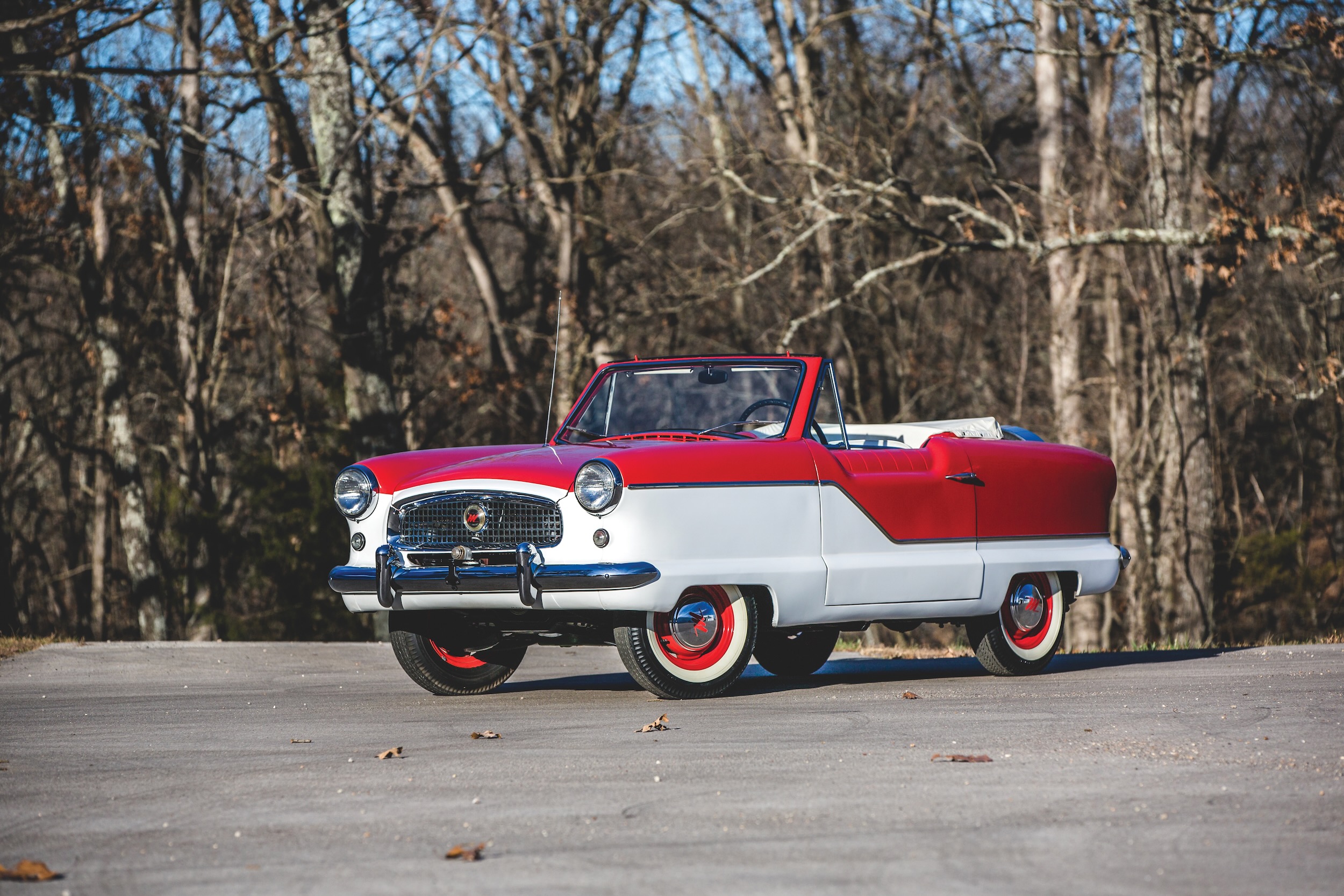
The car was unveiled in October 1953, and production of the car, initially called the NKI Custom, began. Visually, it was based on its larger siblings with their characteristic covered front wheels. It was available as a coupé or convertible and was powered by the Austin A40 engine, a 1.2-litre with 42 SAE hp. The chassis corresponded to that of the Austin A35. A radio was standard, and in the absence of a rear boot lid, a small-format continental kit was included – an external spare wheel. All models were destined for the USA, where the car was to be sold to women with merchandise items. This was difficult because, thanks to power steering and automatic transmissions, large station wagons were becoming popular as family cars, not small cars. In 1954, Nash merged with Hudson to form American Motors, and the Metropolitan was now available as both a Nash and a Hudson.


The Nash Metropolitan arrived in Switzerland in 1954. Austin also acquired the licence for markets outside the USA at the end of 1956. There, the cars soon wore out their tyres. When the more powerful 1.5-litre BMC B engine with 60 SAE hp became available in 1956, dealers had to get rid of thousands of unsold Metropolitans. Shortly afterwards, the Nash and Hudson brands were history, and AMC had presented the Rambler as its new small US car. In 1959, the Metropolitan was given a boot lid, but in April 1961 Austin ceased production. Almost 100,000 Metropolitans had rolled off the production line in Longbridge (UK) since October 1953, 9,400 of them as Austins for the domestic market and Europe – with their own chassis numbers. Today, the Metropolitan has a loyal fan base, and thanks to Austin technology, there are few problems with the supply of spare parts. Flajole was ultimately proven right, however, and a small car soon appeared in US suburbs: the VW Beetle.


We have more exciting American cars in our archive..
Be First to Comment