

Sent into the desert
When tractor manufacturer David Brown first bought Aston Martin for £20,000 in 1947 and shortly afterwards also acquired Lagonda for £52,000, he received a mountain of debt for his money at Aston – and at Lagonda, the glory of a Le Mans victory, a very fine V12 and W.O. Bentley, including the redesign of a six-cylinder engine. Why Brown still preferred Aston Martin is somewhat inexplicable, and we all know what the consequences were: Brown never made any money with Aston Martin; on the contrary, he had to sell it in 1972. The new owners revived the Lagonda name, but the model built between 1976 and 1990, the true wedge, was too unusual to be successful. Anyway, in 2008 it was announced that the Lagonda brand would be revived. And in 2009, an Aston Martin Lagonda was indeed on display at the Geneva Motor Show, a peculiar vehicle, quasi an SUV, which had been developed in collaboration with Mercedes. But, as so often with the English, nothing came of it. The next attempt came a few years later, when Marek Reichman designed a four-door saloon based on a Rapide, which was presented again in Geneva in 2014.
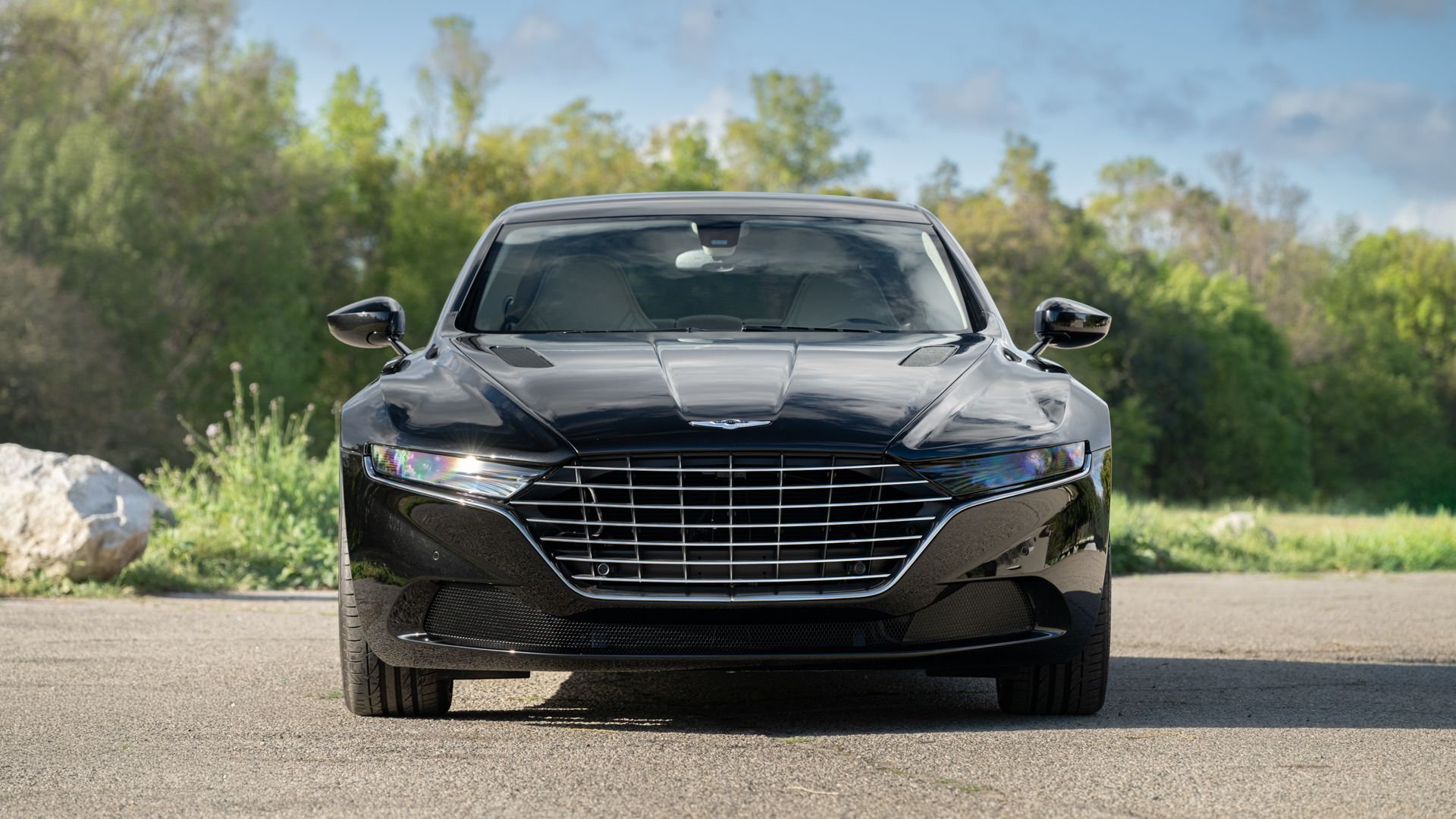


It was actually a good piece of work. The body was made of glass fibre reinforced plastic so that the weight of the 5.4-metre-long four-door car (wheelbase 3.19 metres) could be kept to just under 2 tonnes. Under the bonnet was a 5.9-litre V12 engine produced by Ford in Cologne, which delivered 540 hp and a maximum torque of 630 Nm. This enabled the Taraf to accelerate to 100 km/h in 4.4 seconds and reach a top speed of 314 km/h. However, the name was somewhat peculiar: Taraf was also the name of a Turkish newspaper that was banned by President Erdogan in 2016. The Taraf had a special connection to the Middle East: Aston Martin decided that the luxury saloon should only be offered in this region. 100 units were to be built in Gaydon, and the then CEO Ulrich Bez gave the thumbs up on the price, estimating it at $1 million. When Andy Palmer took over in 2016, he increased the production target to 200 units and had the Taraf offered in Europe, the USA, Singapore and South Africa as well. Shortly afterwards, production came to an end, with four more units of an even more expensive ‘Final Edition’ being produced. It can be assumed that a total of 120 Tarafs were sold.


Aston Martin Lagonda Tarafs are now coming onto the market again and again. What is astonishing is that most of these vehicles have hardly any kilometres on the clock, meaning they are still in new condition. And they are actually bargains, costing less than half the price of a new car. And you hardly ever see them in Central Europe. The vehicle shown here, chassis number SCFTMDCS6HGS50062, came directly to the USA in 2018, has less than 500 miles on the clock (sic!) and will be auctioned by Broad Arrow on Amelia Island in 2026; it is expected to fetch between $500,000 and $700,000.


More Lagonda? Gladly.