
Almost
Malicious tongues claim that Porsche helped draft the new FIA racing regulations at the end of the 1960s and again in the 1970s. In any case, it is astonishing how early the Stuttgart-based company knew about the major changes, such as in 1967, when the FIA virtually overnight limited the displacement for prototypes for the 1968 season to 3 litres. It is said that Porsche was well prepared for this, with its development department already working on a brand new eight-cylinder engine with a displacement of three litres when the new regulations were officially announced in October 1967. It is certain that Ferrari was not at the same level as Porsche, which is why the Italians were so angry that they did not even compete in the World Championship races in 1968. Be that as it may, Porsche had a new engine, again a boxer, eight cylinders, three-litre displacement, four chain-driven overhead camshafts, aluminium cylinders and cylinder head, and a magnesium crankcase. In its first stage of development, the 178-kilogram engine produced 350 hp at 8400 rpm. Of course, this also required a new racing car, the 908, with an aluminium space frame and a plastic body, available in various versions, as an open Spyder or as a coupé with a short or long rear.


Jo Siffert and Vic Elford secured victory right from the first race, the 1000 kilometres at the Nürburgring. There was a double victory at Zeltweg, so Porsche had high hopes of finally securing overall victory at the 24 Hours of Le Mans in 1968. Four Porsche 908s travelled to La Sarthe, Jo Siffert also set the fastest training time, but in the race the eight-cylinder Porsches proved to be unreliable, three vehicles retired, and third place (behind an actually outdated 907 and winners Rodriguez/Bianchi in a Ford GT40) was disappointing. And somehow it was already clear that the Porsche 908 would probably never have a great career. The FIA had changed the rules again, allowing sports cars to be built from 1969 onwards, with only 25 units required. Porsche knew about this early on, too, and in March the 917 was unveiled at the Geneva Motor Show – the 12-cylinder was to become the Stuttgart-based company’s racing machine for the really big victories. Further development of the 908 stalled. Porsche won the world championship title in 1969, but at Le Mans the 908 only managed second place, despite Hans Herrmann’s heroic battle with Jacky Ickx/Ford GT40, ultimately finishing just 120 metres behind the runner-up.


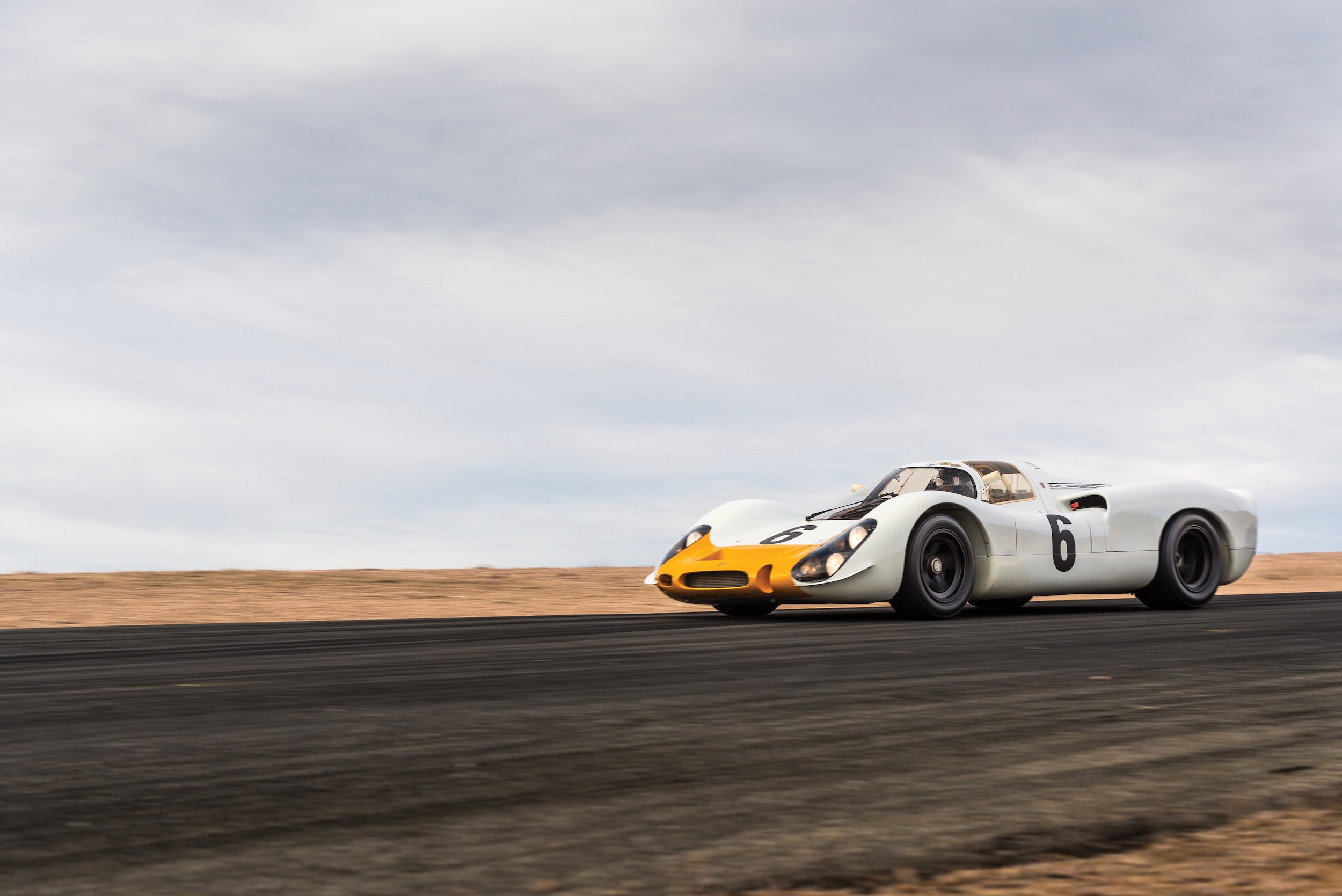
Because the 917 initially proved difficult to drive and then uncompetitive on slower tracks, the 908 was improved for 1970. Jo Siffert/Brain Redman won the Targa Florio in a 908/03 in 1970, while Ahrens/Elford (1970) and Elford/Larousse (1971) won the 1000 kilometres at the Nürburgring. With private teams and then mostly equipped with the new 2.1-litre turbo engine, the 908s achieved good results until the early 1980s. The vehicle shown below is the Porsche 908/02.005, which finished third in the 1970 24 Hours of Le Mans with Lins/Marko – and also appeared in a few scenes in Steve McQueen’s film ‘Le Mans’. This historic vehicle was offered by Broad Arrow 2024 with an expected price of a good five million dollars, but the flatfish was not sold.


We have a few more:
VIN: 908-010 (1968)


Auction: RM Sotheby’s, Monterey 2018, estimated price 2.3 to 2.8 million dollars, not sold. It had a nasty accident at Spa in 1968 and then disappeared from the scene for a long time; the engine is correct but not original. (More pictures above)
–
VIN: 908/03-003 (1970)


Auction: RM Sotheby’s, Monterey 2017, sold for $3,575,000. Was the test vehicle for the 1970 Targa Florio, then came second in the 1000 kilometres at the Nürburgring with Herrmann/Attwood. And then it was all over.
–
VIN: 908/03-004 (1970)


Auction: RM Sotheby’s, Amelia Island 2013, estimated price $1.4 to $1.7 million, not sold. With the following information: «According to the research of Dale Miller, a Porsche race car expert and former PCA historian, chassis number 004 was originally designated as a spare chassis to be used for flex testing at the Weissach racing development facility. As a test chassis, 004 was never fitted with a body or raced, and following development, it was stored by Porsche until 1976, when the car was sold to Kremer Racing with a package of spare parts (mostly consisting of suspension pieces). Kremer retained the car as a backup to chassis number 006, which they were then actively campaigning. Never used by Kremer, chassis number 004 and its accompanying spare parts were sold to Bill Bradley Racing, who in turn sold them to Mr. Miller in 1996. In addition to his vast knowledge as a Porsche historian, Mr. Miller is notable as the owner of Miller Historic Motorcars and is a respected trader of rare Porsche prototype race cars. Recognizing this spyder’s unique provenance, Mr. Miller set about a restoration that would finally take chassis number 004 to the status of a complete, fully-bodied, and proper 908/3.»
We have more wonderful stories in our archive.