

Palpitations
Something had to be done, even if the sales figures of the Porsche 924 introduced in 1975 were good. So good, in fact, that the “housewives’ Porsche” enabled the Stuttgart-based company to survive (even if cast-iron Porsche enthusiasts don’t like to read that now). However, there was one problem: the same 2-litre engine that powered the VW Transporter LT provided the propulsion. With its 125 hp, it really wasn’t the sort of thing that brought tears of joy to the eyes of female drivers. In 1979 Zuffenhausen finally had a change of heart and gave the four-cylinder a new cylinder head with hemispherical combustion chambers as well as a KKK turbocharger, which brought the power up to 170 hp at 0.7 bar boost pressure. With this, the Porsche 924 Turbo (type 931) accelerated from 0 to 100 km/h in less than 8 seconds and reached a speed of over 220 km/h.


Then a lot of things actually happened. With the introduction of the Turbo, the basis was created from 1979 onwards so that these first water-cooled Porsches could also cut a good figure on the race track. In that year, development began on a vehicle that complied with Group 4 regulations and could consequently also compete in the 24 Hours of Le Mans. There was a 5-speed claw gearbox, a limited slip rear differential, the brakes from the 935, lots of lightweight construction, dry sump lubrication – and about 375 hp for a weight of less than a ton. The Porsche designated as the 924 GTP (Type 939) made it to a respectable 6th place overall at Le Mans – the “tranny” had arrived on the race track.
This experience then flowed into the 924 Carrera GT (Type 937), of which exactly 406 examples were built in 1981. But it is not only quite rare, it is also quite rough. The wing extensions made of fibreglass are an eye-catcher together with the air scoop, but the interior largely corresponds to that of the 924 Turbo. The highlight was certainly the two-litre turbo, which was increased to 210 hp with lighter forged pistons, hardened camshafts, a revised cylinder head, increased compression from 7.5 to 8.5:1 and more turbo pressure (0.75 bar). The five-speed gearbox was also strengthened, and a limited-slip differential was available as an option. An acceleration value of 6.9 seconds from 0 to 100 km/h and a top speed of 240 km/h made the Type 937, which cost around 60,000 D-marks at the time, a very fine sports car. You also have to classify it: a 911 SC in the early 80s came with 204 hp, weighed 1180 kilos and was “only” 235 km/h fast.


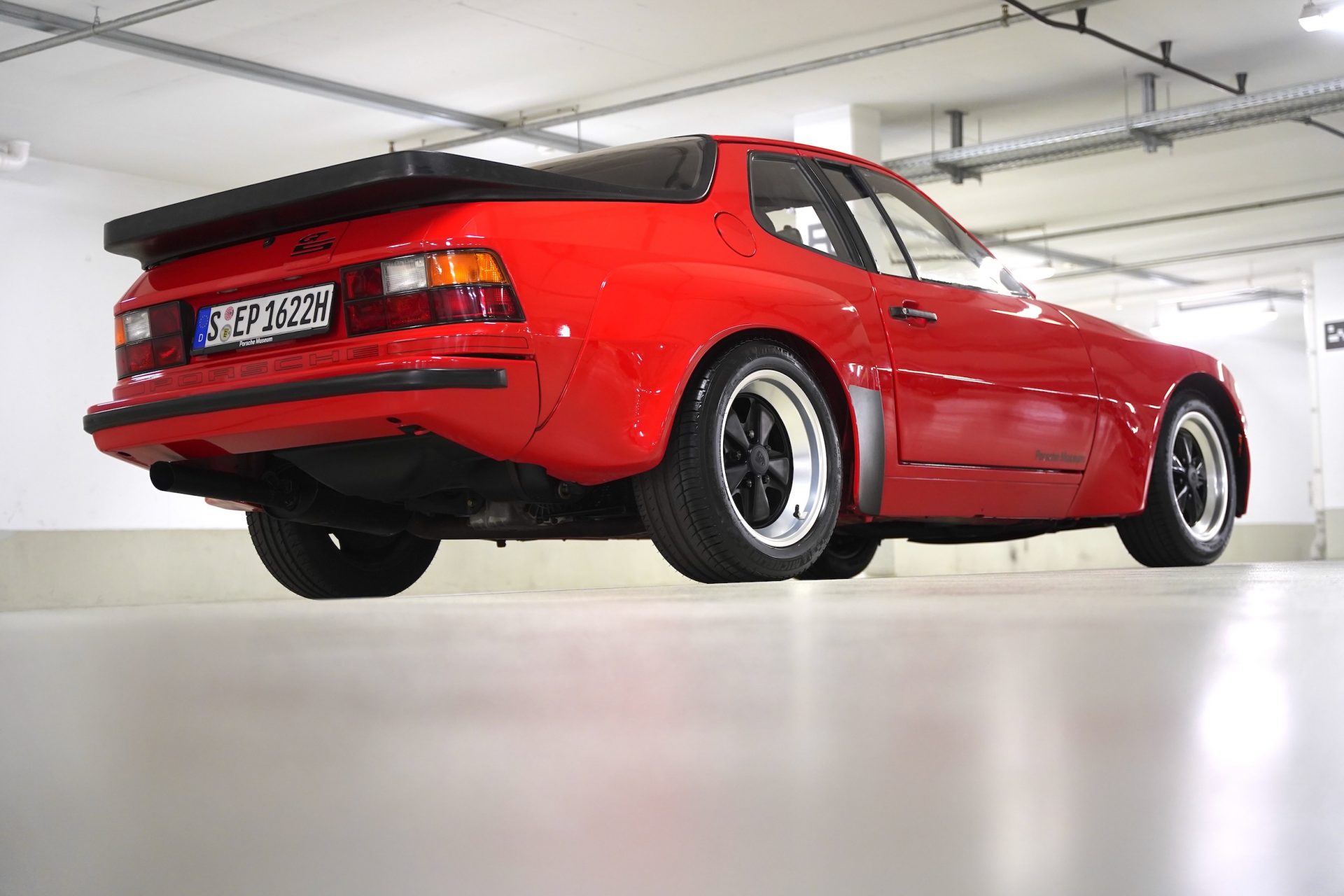
But the Carrera GT, which quickly sold out, was not the end of the line. Even then, Porsche understood that it was not only possible to earn good money with special vehicles, but also to fill every gap in the regulations, as long as the corresponding basic vehicle was put on the road in the right numbers. This was the birth of the Porsche 924 Carrera GTS (still called Type 937). Probably 44 examples found their way to the customers, despite a horrendous price of 110,000 D-Mark; those who added another 15,000 D-Mark received a Clubsport, which offered a little less for more money. The bodywork became wilder again, mainly thanks to extensive lightweight construction measures. Bonnets and doors were made of lightweight plastic, all windows except the front one were made of Makrolon. Even the characteristic folding headlights had to give way to a fixed solution covered by plastic lenses. The reduced combat weight of only 1,121 kilograms was replaced by a significantly more powerful engine. The boost pressure was increased to 1.0 bar and the peripherals were adapted accordingly. Porsche itself gave the engine a rather pessimistic 245 hp and 335 Nm maximum torque, but this already from 3000 rpm. The top speed was increased to 250 km/h and the sprint time was reduced to 6.2 seconds. The sports suspension had classic wishbones and McPherson struts at the front, cast aluminium sloping links with coil springs at the rear, stabilisers and Bilstein gas pressure shock absorbers; the internally ventilated and perforated dual-circuit disc brakes came from the 911 Turbo, as did the wheel hubs.


And then there it is, behind the Porsche Museum in Stuttgart and in front of us, the naturally bright red Porsche 924 Carrera GTS (apparently there was one in white, the prototype – and then another one in gold, but that’s a whole other story, which we will also tell). We take a seat and are amazed at the comfort: there is none. The sports seats from the Porsche 935 are bone dry, the entire interior is lined with nasty needle felt, Stuttgart wanted to do without insulation material. That’s a good thing, who needs a radio when you want to drive a bit faster? And that’s what we do, starting in Zuffenhausen and heading towards Weissach for a few nice laps on winding country roads.


Even though we have driven some very nice cars in the past decades, it rarely happened to us that we immediately felt comfortable, that we felt understood by the car and vice versa. The road holding is perfect, the balance anyway, the steering a poem. With the gearbox it’s a bit of a struggle, first gear on the back left, so you have to rethink. And apply power. The 2-litre engine wants to be kept happy, without turbo support there is not much going on, but with additional ventilation there is a storm. You can step on the brake pedal heartily, but then the Porsche becomes light at the rear before the bend, and you have to be aware of that. But that’s exactly how it should be, we want to be alert, understand the reactions of the car, know what works and what doesn’t – and all that self-determined, not with the help of two computer centres full of electronics. The Porsche 924 Carrera GTS is not completely overpowered, but light, agile, wonderfully controllable, so that the driver is not overwhelmed and can push the limits. And at some point a wonderful feeling sets in: Yes, it’s exactly this car, exactly this “tranny” that always stood in the deep shadows behind the 911, is something like our dream car. We like each other. Very much so. It’s love at first drive.

More fine cars can be found in our archive. Or have you already tried the search?