
Need for explanation
- The brand’s first SUV
- Surprisingly not with 800 V architecture
- Available for order now, delivery not until the end of 2023
For “radical zero”, we have set ourselves the goal of explaining e-mobility as well as possible. Because there is still a lot of need, not all electric vehicles are the same, and some things still require a hopefully comprehensible description. For example, the difference between a 400-volt and an 800-volt architecture. Of course, more is always better, but an 800-volt system is more expensive, but it also has a not insignificant influence on the charging behaviour of an electric car: it simply charges faster.

The calculation is simple. Let’s take an Ionity charger, which are currently the fastest in Europe. It can deliver 350 kW, theoretically, but it certainly delivers electricity at a fused 500 amps. 500 A times 400 V is quite simply 200 kW. To make it clear: 500 A times 800 V is 400 kW. The Ionity charger, as mentioned, manages 350 kW, so it is actually overtaxed by the 800 V architecture. That’s why the corresponding suppliers, i.e. currently Porsche/Audi, Hyundai/Kia and, most recently, Maserati, throttle their systems down to around 250 to 270 kW charging speed. Also to protect the batteries.

And now we come to the Polestar 3, which is based on the all-new SPA2 platform, just like the Lotus Eletre and also the Volvo EX90 (to be presented on 9.11.2022). SPA2 has a very classic 400 V architecture, like most other electric vehicles, such as Volkswagen’s MEB or Renault/Nissan’s CMF-VF or Stellantis’ eCMP or BMW or Mercedes or Tesla. Polestar, however, now states a maximum charging speed of 250 kW for its new model. However, as calculated above, this is not possible with the current state of the art, 400 V multiplied by 500 A equals only 200 kW with the best will in the world. Perhaps, in the distant future, more will be possible, Tesla is currently working on a gentle, gradual increase. But as we all know, Tesla has a few years’ head start in technology, not only in infrastructure, but especially in charging technology.

While it may still make sense – for now – to stick to the 400 V architecture for mid-range e-vehicles and models with smaller batteries, mainly for cost reasons, this is definitely not the case for the new Polestar 3 and the SPA2 platform. The Chinese SUV has a massive 111 kWh battery (107 kWh net), so as much power as possible has to go in as quickly as possible, otherwise the charging times become absurd. Polestar writes in its press release that the new SUV can be charged from 10 to 80 percent SOC with 250 kW within 30 minutes.

This is true on the very patient paper, 70 per cent of 107 kW is 74.9 kW, this divided by the stated 250 kW, so a full charge would theoretically even be possible in 20 minutes. At least Polestar is honest enough to admit that no electric car can do this fully, at 40 per cent SoC everyone breaks in for the first time, at 60 per cent SoC once again and even more, so the 30 minutes are more than just optimistic.

Now, with the Polestar 3, we currently get a maximum of 200 kW, so we add another fifth to that and we’re at 36 minutes. In fact, without preconditioning and all the bang that nobody is interested in anyway in real life: one hour. That, let’s be kind, includes leaving the motorway, looking for the charging station, plugging it in, pulling out the card, waiting for the connection when charging, waiting for the connection when breaking off, unplugging, getting back on the motorway. The huge battery theoretically offers advantages in terms of range, but in real life no one is interested in that (any more); it’s all about the real time between 10 and 80 per cent SoC. (In the future, this will be the key parameter in the “radical zero” tests).

Short-distance drivers and home refuellers at the wallbox won’t care, they’ll suck 11 or maybe even 22 kW out of their wallbox overnight (with the Polestar 3, by the way, it’s only 11, another disillusionment). And gutis. (But then we would urgently have to write about the charging losses, but we’ll do that in the test of the Skoda Enyaq (coming soon), where we meticulously measured them – and came up with a very sobering result. Let’s just put it out there: 20 percent. That’s like pouring a litre on the floor after four litres of petrol). Long-distance drivers, however, who stand at the fast charger because they want to charge quickly, are very interested in this. And that’s where the Polestar 3 now somehow finds itself in need of an explanation. We asked the Swiss importer for a statement on this, but unfortunately received nothing.

Again, we are already very surprised by this. Polestar’s parent company, Geely, is otherwise extremely progressive. Also very, very fast in development, even faster than Toyota. As early as next year, the first vehicles from Zeekr, another Geely subsidiary, will come with a pure sodium battery (so there will be no need for the evil lithium). And the first solid-state batteries have been announced for the end of next year, which will change the game completely anyway: these batteries need much less space with a higher energy density. As a result, new, more compact and thus lighter platforms can be constructed. SPA2 is then already obsolete again, because this current platform, which is primarily used for luxury products, has: nothing of all that. Not even an 800 V architecture.

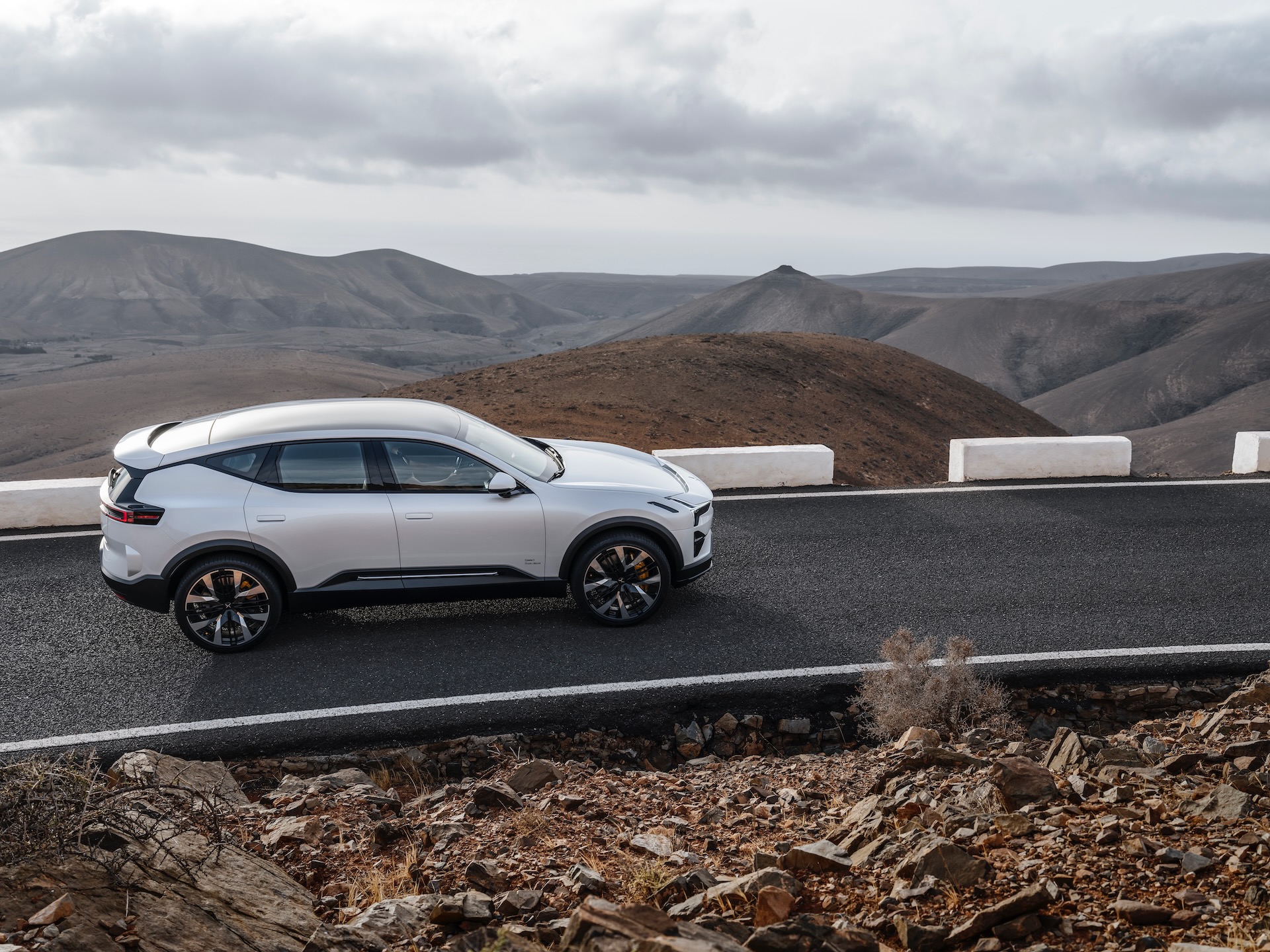
But back to the Polestar 3. This will probably be a good one, this first SUV from the Chinese brand. Visually, Polestar is breaking away from Volvo, which is a good thing. Thomas Ingenlath, Polestar’s CEO, has certainly played a significant role in this; Ingenlath, who once worked for VW and Volvo, is probably the first designer to have made it to the head of the brand. And with him, you can be sure that the greatest value is always placed on looks and styling and subtleties such as a clean light signature. As an SUV, the 3rd Polestar hits the nerve of the times anyway, so it will also be forgiven for the soft coupé shape, which then costs it quite a bit of boot space. A little over 400 litres, that’s what a VW Golf can do – and compared to its declared competitor Tesla, that’s a tired joke.


The technical data are somewhat impressive: the “Long Range” variant comes with 360 kW of power and 910 Nm of maximum torque, and the range is supposed to be 610 kilometres according to WLTP. With the Performance package, it is less kilometres, but 380 kW and 910 Nm maximum torque. The faster Polestar 3 runs from 0 to 100 km/h in less than 5 seconds – which is less impressive, as the most powerful Tesla can reach 100 km/h in just over half the time. This could be due to the fact that the Polestar 3 weighs a hefty 2.6 tonnes, at least. A dual-chamber air suspension, which can also be set to sporty, then the chassis is calibrated to be emphatically rear-heavy, ensures a comfy driving experience. The rear axle is also automatically decoupled so that the all-wheel drive vehicle can save energy when rolling in.

Where the SUV will be at the very, very top, however, is in the more than ample safety and other assistance systems. The Polestar has the latest Android operating system from Google – and no fewer than five radar modules, five cameras and twelve ultrasound modules. It is also the first vehicle to come with an optional control unit from Nvidia. This includes three more cameras and four ultrasonic sensors that scan the vehicle’s surroundings in real time. On the one hand, this is a preparation for fully autonomous driving. And above all, it offers even greater sensitivity to the abundant safety systems. Finally, the interior is monitored by two more cameras, which are intended to support the driver’s attention. Of course, the probably frequent software updates are carried out “over the air”. It can also be bidirectional.

The Polestar 3 can be ordered now, the price scale starts at 99,900 Swiss francs, plus various packages that are not quite cheap. The first vehicles will be produced in the Chinese plant in Chengdu from mid-2023, with the first deliveries expected in the fourth quarter of 2023. In 2024, Polestar will open a new plant in the USA.

More electric cars can be found at: zero. And then there is the archive.