
Tuning
VIN: ZFFGJ34B000084326
Engine: –


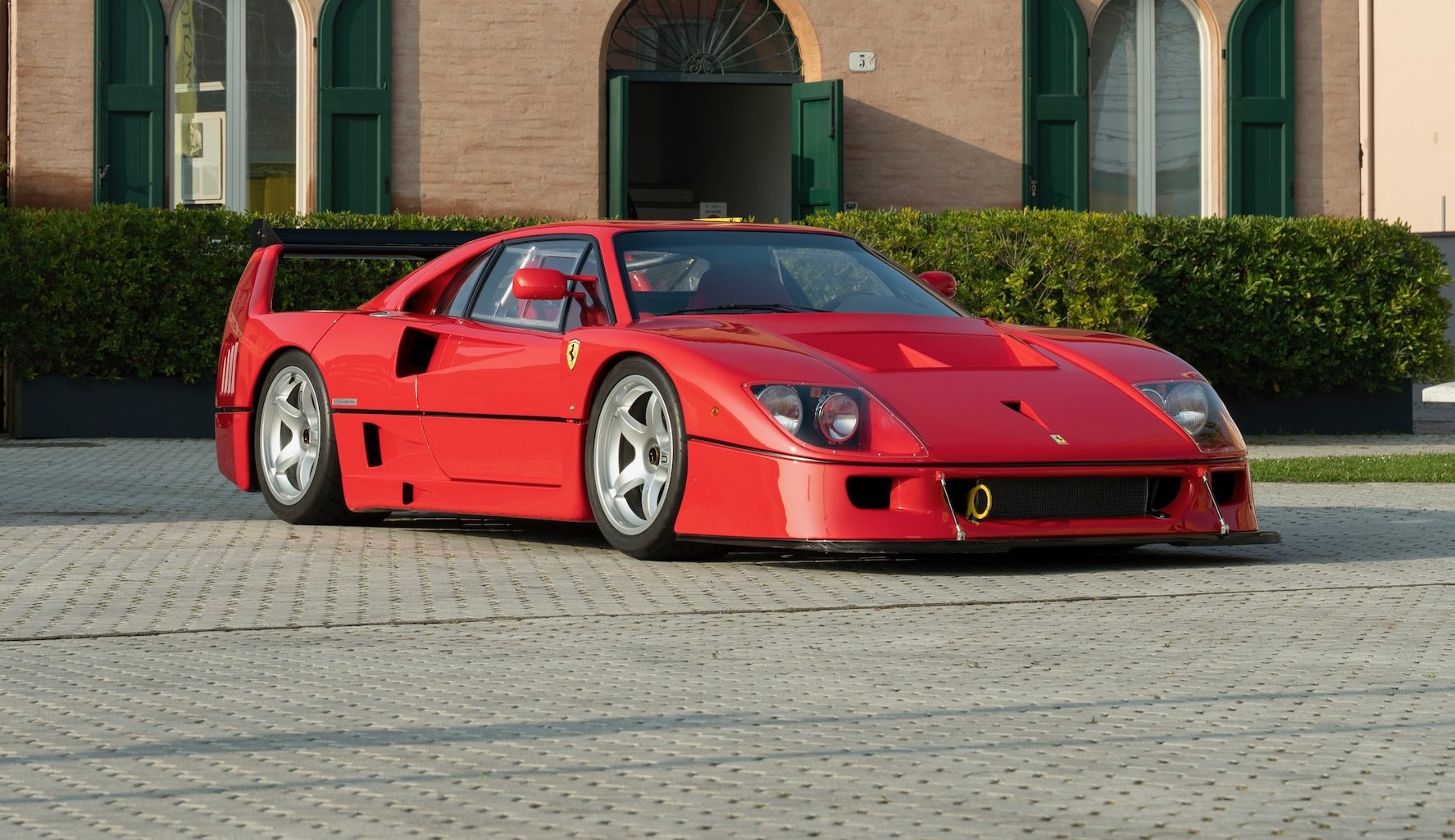
Auction: RM Sotheby’s, Monaco 2026, estimate 2,25 to 2,75 mio. Dollar, with these informations: «According to a history report by Marcel Massini, chassis 84326 was completed on 1 March 1990 as a European-specification, road-going example with roll-up windows and was delivered new to a German enthusiast through Ferrari Deutschland GmbH in Wiesbaden. The first owner was a passionate devotee of the marque who regularly displayed the car at Ferrari gatherings and track events across Europe, including appearances at Mugello in 1992 and Spa‑Francorchamps in 1993.
In 1994, chassis 84326 was sent to noted German tuner Richard Hamann of Hamann Motorsport in Laupheim. Having built his reputation through successful BMW tuning programs, Hamann recognised an opportunity to expand his operation into the development of Ferraris. Seeking to extract maximum performance from the F40 platform, Hamann enlisted the expertise of Swiss engineer Peter Sauber—the founder of the renowned Sauber Formula 1 team—under whose guidance the Ferrari V-8 received twin KKK turbochargers with increased boost and dual wastegates, along with a host of reinforced internals. These modifications dramatically elevated the engine’s performance, with output reportedly reaching as much as 700 horsepower.
Coupled with a revised nose inspired by the F40 LM, as well as an enhanced rear wing for greater stability and upgraded brakes and suspension, the competition-modified F40 was featured on the cover of the June 1994 issue of Motor magazine, where it was praised for its sharper driving dynamics and stronger low-end power delivery. Envisioning a limited line of tuned F40s, Hamann’s conversion was far from inexpensive—reportedly costing as much as 75 per cent of a standard F40’s original sticker price, in addition to the cost of the donor car itself.
Eager to demonstrate the car’s performance potential and justify its extraordinary price tag, Hamann sought to enter the car in competition. Regulatory changes ahead of the 1996 season allowed him to partner with Jörg Hartmann Motorsport and campaign chassis 84326 in the BPR Global GT Series. However, as was often the case for independent GT teams of the era, limited funding hindered both development and reliability. During the 1996 BPR season, the car retired at the Nürburgring and later recorded a 26th-place finish at Spa-Francorchamps.
Chassis 84326 then passed through a succession of German enthusiasts before moving to the United Kingdom in the early 2000s. Over time the car fell into neglect and was eventually stored in a barn in the north of England, where it remained largely forgotten until 2012. That year it came to the attention of a passionate Ferrari enthusiast, who had been fortunate enough to secure an F40 when new and had long carried the regret of parting with it.
The car was sent to the respected Ferrari specialists at Moto Technique Ltd of Surrey, led by experienced hand in all-things-Ferrari Kevin O’Rourke, where it became clear that years of hard racing had taken a severe toll. The suspension components were worn beyond repair, the braking system required complete replacement, and the fuel tanks were in extremely poor condition. Evidence of an electrical fire was even discovered beneath one of the tanks. At this stage the project evolved from a simple refurbishment into a comprehensive restoration carried out with an uncompromising philosophy. The car would be returned to as-new condition, while subtly benefiting from modern engineering knowledge. Michelotto Automobili supplied newly fabricated suspension assemblies, braking components, and numerous specialised parts crafted from Avional aluminium, magnesium, and titanium. The bodywork also required significant attention, as certain areas had previously been repaired in fibreglass rather than the original carbon-Kevlar composite. To restore proper weight and structural integrity, the front clamshell was completely remanufactured in the correct carbon-Kevlar construction, while other panels underwent extensive refinishing to reveal the subtle carbon weave beneath the paint—replicating the appearance seen on factory-fresh examples. The engine rebuild was entrusted to renowned engineering firm Crosthwaite & Gardiner, who carefully inspected every internal component and renewed where necessary, resulting in a fully rebuilt power unit capable of delivering its formidable performance with confidence. To enhance reliability and drivability, a multi-stage engine management system from MoTeC was integrated, providing three selectable power modes of approximately 550, 650, or 720 horsepower respectively, allowing the driver to tailor performance while preserving mechanical longevity. Every component—from suspension to fuel system to gearbox—was repeatedly assembled and removed to achieve ideal alignment and finish. The result is a car restored with extraordinary attention to detail, blending historical authenticity with carefully considered improvements. Following the completion of its restoration, the car achieved notable recognition as the cover feature of evo magazine, issue number 217. In the accompanying article, written by Richard Meaden and titled “No Retreat, No Surrender”, the publication presents a comprehensive exploration of the car’s provenance, driving dynamics, and restoration process.»


A collection of Ferrari F40 you can find: here (just in German, sorry, English still work in progress).