
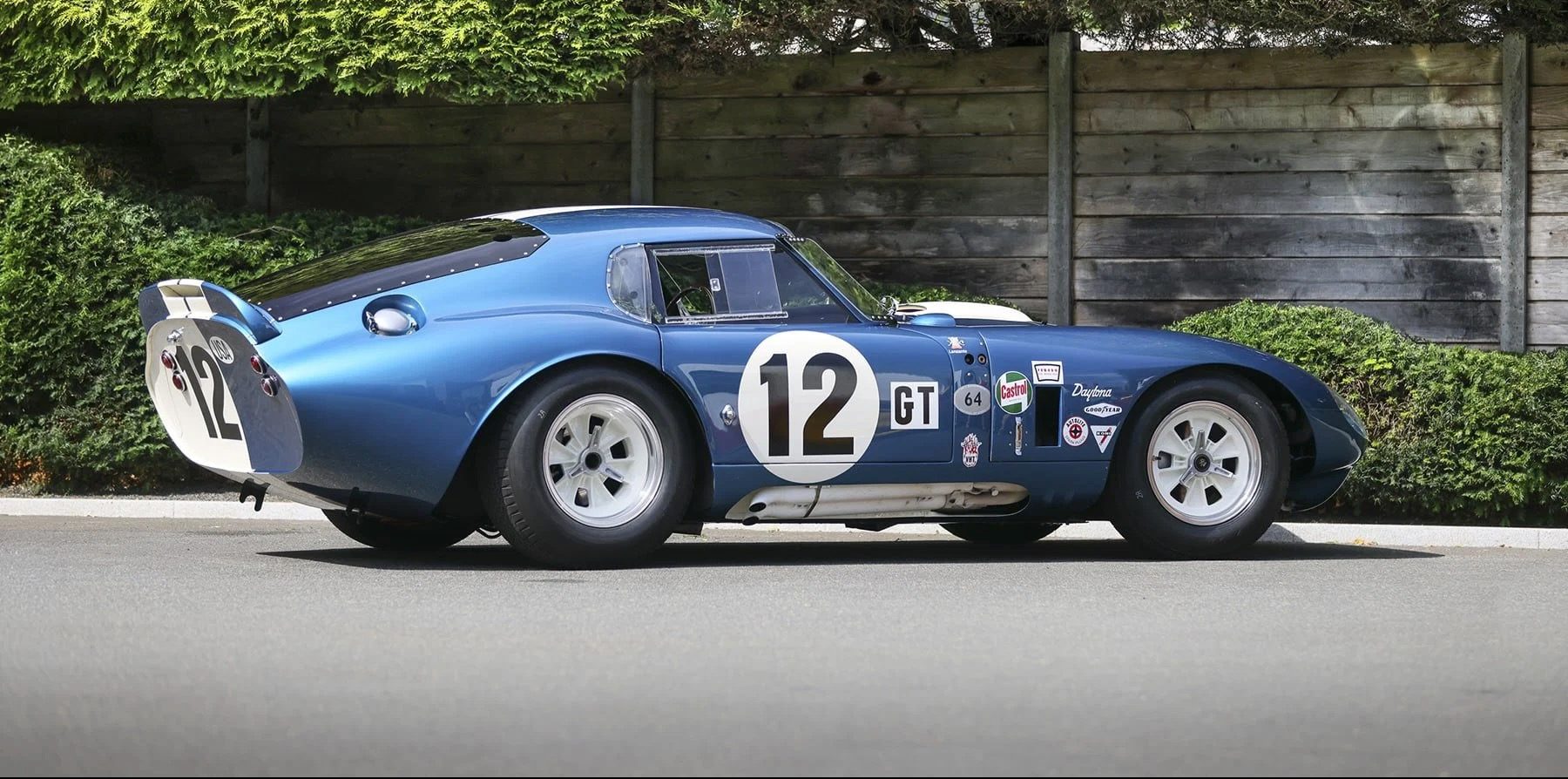
National treasure
Of course, the Cobra was magnificent. What Carroll Shelby had put on the road from 1962 onwards – that blend of the AC Ace’s European chassis (admittedly a little dated by then, but very light yet sturdy) and the sheer power of American Ford engines – was nothing short of a revolution; it changed the world of sports cars forever (even if we in Europe still haven’t grasped the significance of the Cobra). But on circuits with longer straights, the roadster naturally didn’t stand a chance; the aerodynamics simply weren’t up to it. That was clear to the old hand Shelby – and he had the right man on his team in Peter Brock. Brock had spent his formative years at GM, working on the C2 Corvette and the Sting Ray, amongst others, and was the first employee to be taken on permanently by Shelby America.


When Shelby and Brock came to the conclusion that the much-hated Ferraris – the 250 GTO in particular was Shelby’s arch-enemy – could only be beaten on European racetracks with a coupé, Brock developed a car that was completely different from the Cobras that had come before. Naturally, they stuck with the AC chassis, but on top of that Brock created a coupé design with a long roofline and a notchback rear. And yes, he also created one of the most beautiful racing cars of all time. He’d clearly studied the 250 GTO closely, and no doubt the Corvette Grand Sport (which made its racing debut a year before the Daytona Coupé), yet the Shelby was unique, brutal, and yet elegant. And fast, too: right from its very first race, the 1964 24 Hours of Daytona, the prototype, CSX 2287, was faster than all the Ferraris – until a carburettor fire forced it out of the race. At the 12 Hours of Sebring, it secured a class victory.
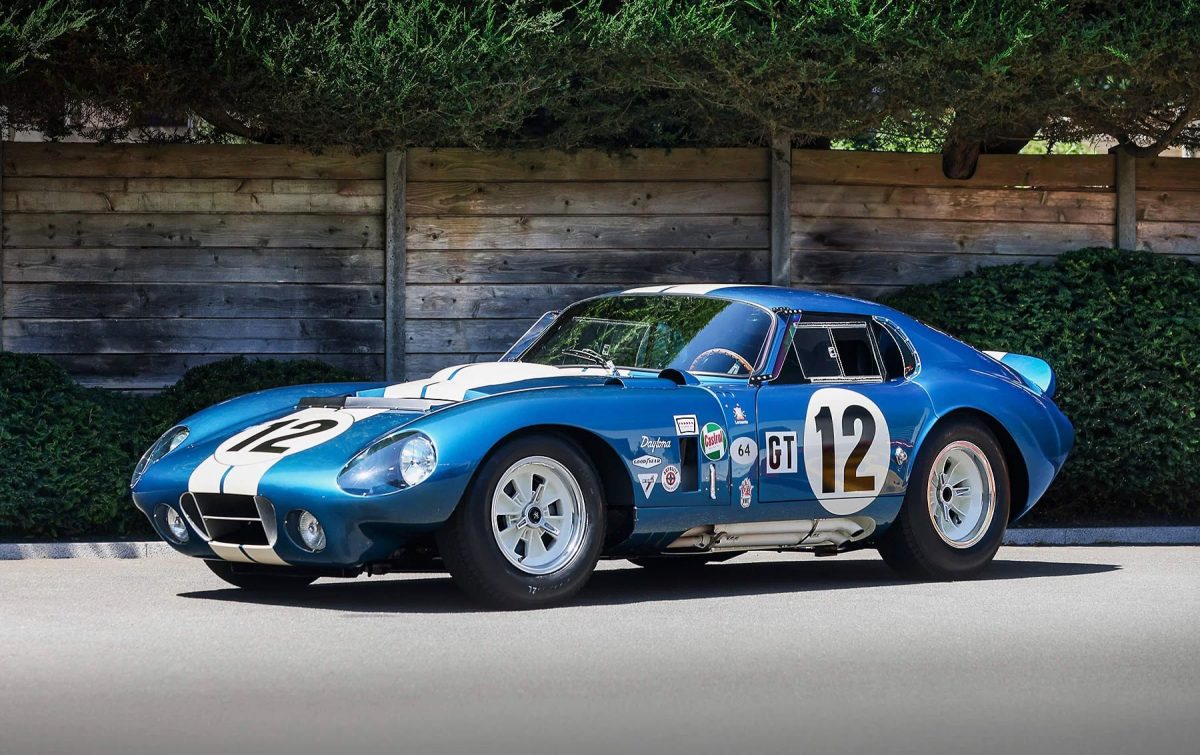
As always with Shelby and the Cobras, there are so many stories to be told. Let’s go through all the chassis numbers:
CSX 2286: Shelby knew from the outset that with the 289 engine there was no chance of overall victory, at least not at Le Mans. New Zealander John Ohlson, who also worked on the prototype (i.e. CSX 2287), extended the chassis of CSX 2286 to accommodate the legendary 427. He did this in Modena at Carrozzeria Grandsport, which was responsible for the aluminium bodywork. However, Ohlson was concerned that the large engine might overheat, so he installed a 390 racing engine instead, but encountered massive difficulties because Ford was unable to supply the necessary parts. It was not until Le Mans 1965 that the CSX 2286 was finally ready, but it retired after clutch problems. The car was later brought to the US, converted for road use – and in 2012, its then-owner S. Robson Walton crashed it so violently into the crash barriers at Laguna Seca that the car was effectively written off. Naturally, it was rebuilt. Shelby, that little Münchhausen, spent many years telling the story that CSX 2286 had been on its way to Le Mans in 1964, where it would undoubtedly have swept the board with its 427 engine, but then fell off the transporter; Shelby, the former chicken farmer, had plenty more stories to tell when the day was long.
CSX 2287, the prototype: Peter Brock took the chassis of a roadster that had crashed at Le Mans in 1963, modified it as he saw fit for weight distribution and aerodynamics, put Ken Miles behind the set-back steering wheel, fashioned a template out of wood and tape to mark where the windscreen should go – and then adapted the aluminium mould to fit around it. Miles then carried out 30 days of testing until he gave the go-ahead – by which point the coupé was clocking 310 km/h. It could have gone much faster, as Ben Howard, a specialist from Convair, calculated for Shelby: the rear would have had to be extended by around one metre, but the stingy boss considered the effort too great. CSX 2287 won its class at Sebring in 1964, was subsequently raced extensively, set various records on the Bonneville Salt Flats – and eventually fell into the hands of the mad Phil Spector. But that’s a whole other story, which we hope to tell at length one day.
CSX 2299: Fitted out by Grandsport in Modena, it won its class at Le Mans in 1964, went on to win further races, and led a comparatively quiet life. It is now part of the Shelby American Collection in Boulder, Colorado.
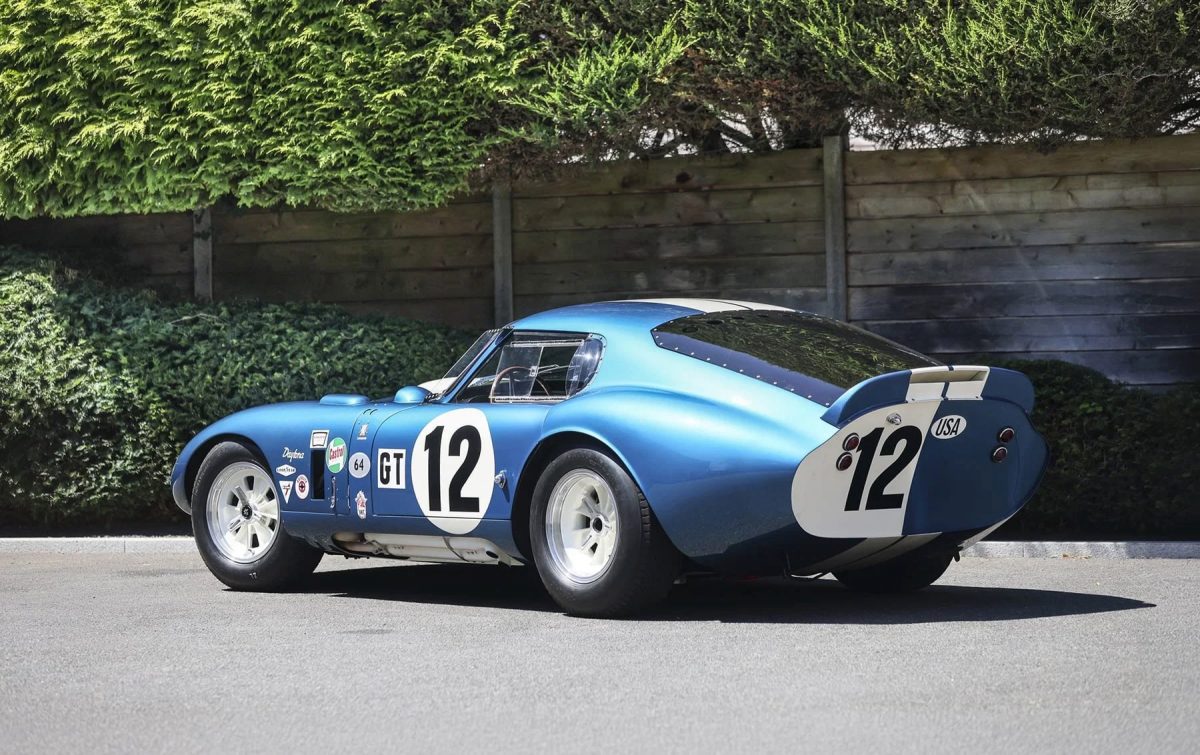
CSX 2300: This is the car we’re featuring here. Broad Arrow is auctioning CSX 2300 in Qualifying 2026, with an estimated price of ‘in excess of $25,000,000’, along with the following details: (see comments).


CSX 2601: Was bodied by Grandsport in Modena in 1965, competed in eight FIA races and won its class four times. It was subsequently purchased by Bon Bondurant and is reportedly now in Argentina.
CSX 2602: Also bodywork by Grandsport, it was entered by the Swiss team ‘Scuderia Filinetti’ in 1965 but retired in the 10th hour. It was later purchased in parts by a Japanese collector.
Yes, Shelby won the 1965 FIA World Manufacturers’ Championship for GT cars with the Daytona Coupé – the first such title for an American manufacturer. But the dreams had been much grander: overall victories at Daytona and Le Mans – which would probably have been possible with the 7-litre engines. However, the small manufacturer Shelby was brought into the GT40 project by Ford and paid handsomely; it would probably not have been very wise, politically speaking, to put a competitor of their own on the track. In 1966, following a change to the regulations, the Coupé’s international racing career came to an end anyway.
More rare US cars: Archive.