
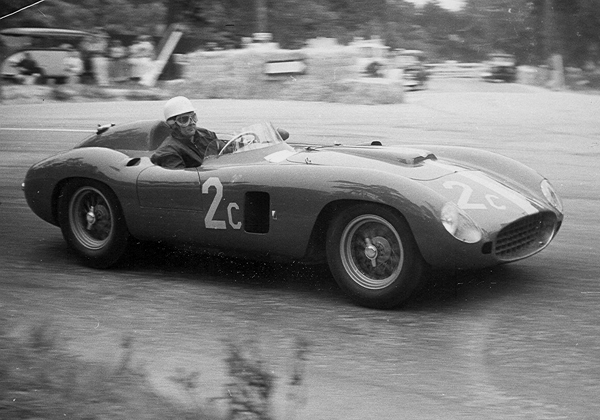
Mystery
One might well think that the history of older Ferraris is known down to the very last detail, right down to the very last screw. After all, there’s a lot of money at stake – sometimes a great deal – and money makes so many things possible, including research. One might also get the feeling that Ferrari itself ought to know absolutely everything; after all, the classics department employs legions of staff, rakes in a great deal of cash, issues certificates for an absurd hourly rate, and turns rust into gold. And yet there are still mysteries, loose ends, grey areas and dark cellars – the Ferrari 860 Monza is one of them.
Naturally, it has something to do with the 857 S described earlier, which failed to bring Ferrari the success it had hoped for. In the autumn of 1956, Lampredi had to return to his dark little workshop – where he redesigned the largest four-cylinder engine in Ferrari’s history (3,491.93 ccm – and, with a bore and stroke of 102 x 105 mm, the only long-stroke engine?). Its power output is said to have risen from 280 to 310 PS, which is why it is also said to have been called the ‘Super Monza’ – and it was successful too, securing a one-two finish with Fangio/Castellotti and Musso/Schell at the 1956 12 Hours of Sebring (as the only four-cylinder car), made it onto the podium at the Mille Miglia with Collins (2nd) and Musso (3rd), and secured another second place with Fangio/Castellotti at the 1,000-kilometre race at the Nürburgring.
And what’s so puzzling about that? Well, it seems very unclear exactly how many Ferrari 860 Monzas there actually were. My favourite source states: two examples, #0602M (2nd at Sebring, 3rd at the Mille Miglia, 2nd at the Nürburgring, then sold to the Marquis Alfonso de Portago, later owned by Pierre Bardinon and DK Engineering) and #0604M (1st at Sebring, also owned by Bardinon at some point). Other sources mention three cars, whilst still others even cite six. The confusion could stem from the 857 S models (#0570M, #0578M, #0584M, #0588M) or perhaps from the 290MMs (#0606, #0616M, #0626, #0628), which shared the same chassis as the 860. We just don’t know for sure – at least, we don’t.
We have more Ferraris in our archive.