
Extension
As is well known, Porsche isn’t exactly great with figures; at the moment, they’re off the mark when it comes to both turnover and profit. But the Stuttgart-based company seems to have a problem with this in other areas too – this has been discussed here on several occasions, for example when the topic was the one-millionth Porsche 911. Take the 911, for instance: first as the 911, then the 964, followed by the 993, 996 and 997, which were then logically succeeded by the 991 and 992. But there are even more examples among the racing cars: the 550, 718, 904, 906, then the 910 and 908. We’ve already written something about all of them; the only one missing is the 907. Which was, in fact, a 910 with a long rear end. An interesting point here is that the 907 was also available with a short rear end. But let’s start at the beginning.


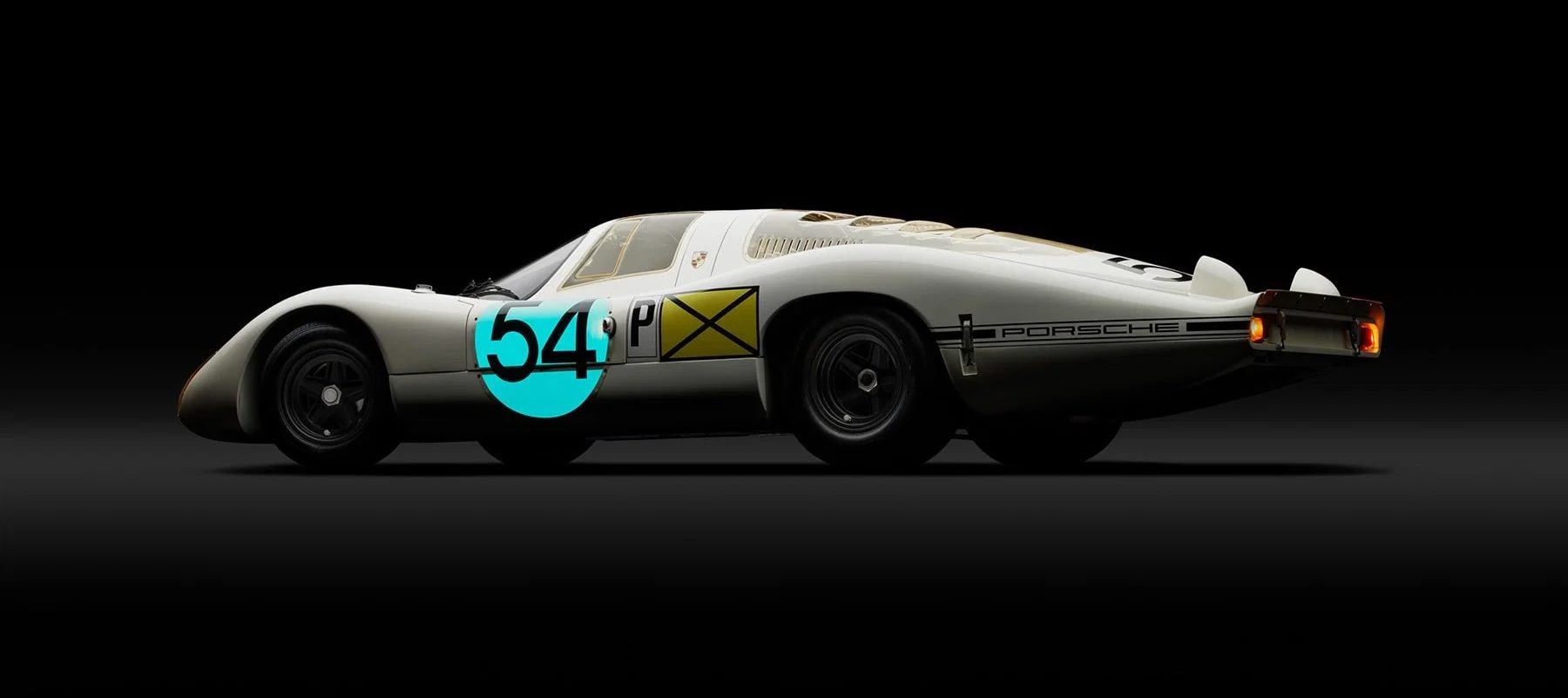
Things then suddenly moved very quickly; even Porsche – which was usually very well informed in advance about changes to the regulations – was caught off guard in October 1967 when the FIA announced a three-litre engine capacity limit for prototypes for the 1968 season. Although this had been anticipated in Stuttgart, it was not expected until 1969; the new three-litre eight-cylinder engine was not yet ready. So the 910 had to be redesigned; there was still room for improvement, particularly in terms of aerodynamics. The 910’s space-frame chassis was carried over virtually unchanged, but the rear was extended by a full 0.5 metres for the 907. Efforts were also made to reduce aerodynamic drag in other areas: the cockpit was made sleeker (and, for the first time in a Porsche racing car, the driver sat on the right), the windscreen was lengthened, and behind the driver there was a transparent plastic canopy with ventilation slots. A completely new feature was a movable flap fitted to the rear edge, which adjusted via the suspension depending on the approach to a bend, thereby promising greater downforce – ‘active aero’, as it would be called today. Initially, the 907s were still powered by the familiar 2-litre six-cylinder boxer engine, Type 901, which produced around 220 PS. This was followed by the new 2.2-litre eight-cylinder, Type 771, which produced an impressive 270 PS.


What is interesting, however, is that the first two 907s competed for the very first time at the 24 Hours of Le Mans as early as June 1967. Siffert/Herrmann finished fifth in the 2-litre six-cylinder (reaching 302 km/h on the Mulsanne Straight), but they comfortably won the index classification, achieving this with a fuel consumption of just 14.51 litres per 100 km. In the first race of the 1968 World Sportscar Championship, the 24 Hours of Daytona, the 907 – now fitted with an eight-cylinder engine – secured a one-two-three finish – partly because Ferrari sat out the entire season and Ford had nothing suitable to offer. At the 12 Hours of Sebring, there was a one-two finish – ahead of two rather production-spec Chevrolet Camaros. But then Ford finally had its 4.7-litre GT40 homologated as a sports car, and it completely outclassed the 907 (and all other Porsches), except at the Targa Florio. The world championship title went to Ford, even though Porsche had a new, very hot prospect in the form of the 907 short-tail from the middle of the season onwards – which was even lighter (aluminium space-frame instead of steel). In 1969, Porsche fielded only the 908 from the works, and from June onwards the 917; the 907s, in both long- and short-tail versions, were sold to private teams.


The car we are showing here bears chassis number 907-005 – and is the winning car from the 1968 24 Hours of Daytona. It’s important to recognise this: although Porsche had secured countless class victories over what felt like an eternity, Daytona ’68 marked their first major overall victory in a major 24-hour race. The car went on to finish second at Monza, was then entered by private teams, returned to Porsche, and was used as a test car for an automatic fire-extinguishing system; unlike the 907-008, which burnt out completely, it survived this without any major damage. From 1989 onwards, the 907-005 was fully restored by a Swede; an American later completed the work, including fitting the matching eight-cylinder engine. The car is now due to be auctioned by Gooding & Christie’s at Pebble Beach in 2026. It is expected to fetch between 4.5 and 5.5 million dollars.


We have more Porsches in our archive.