
Far-reaching
When we set about researching the history of the Ferrari 250 Testa Rossa a few years ago, it was already clear to us: a minefield. You can’t really get it right. We’ve more or less got through these first 250 Testa Rossas, built from 1957 onwards – see here – but then came the TR 58 (0726TR, 0728TR and 0746), then the TR59 (0766TR, 0768TR, often referred to as the TR59/60: 0770TR, 0772TR (?), 0774TR)), the 250 TRI/60 (0780TR, 0782TR), the 250 TRI/61 (0792TR, 0794TR) and a bit of this and that here and there. So, let’s have a go at sorting this out, roughly, at least for the cars officially fielded by the Scuderia: The TR58s featured a new DeDion rear axle; on the TR59s, the engine was shifted slightly to the left to make room for a new 5-speed gearbox; for the TR59/60s, the wheelbase was shortened from 2.35 to 2.28 metres and the gearbox was locked to the rear axle; the TRI60s were made even shorter (wheelbase 2.25 metres) and were fitted with independent rear suspension (hence the ‘I’ in the name). Finally, the TRI61s were actually a completely new design, featuring a tubular space-frame, a 2.32-metre wheelbase, independent suspension and the gearbox mounted on the engine once again. As for the customer cars, all these features were offered – or not – with a year’s delay, and some teams also came up with their own solutions. In other words: each car must be considered on a case-by-case basis.


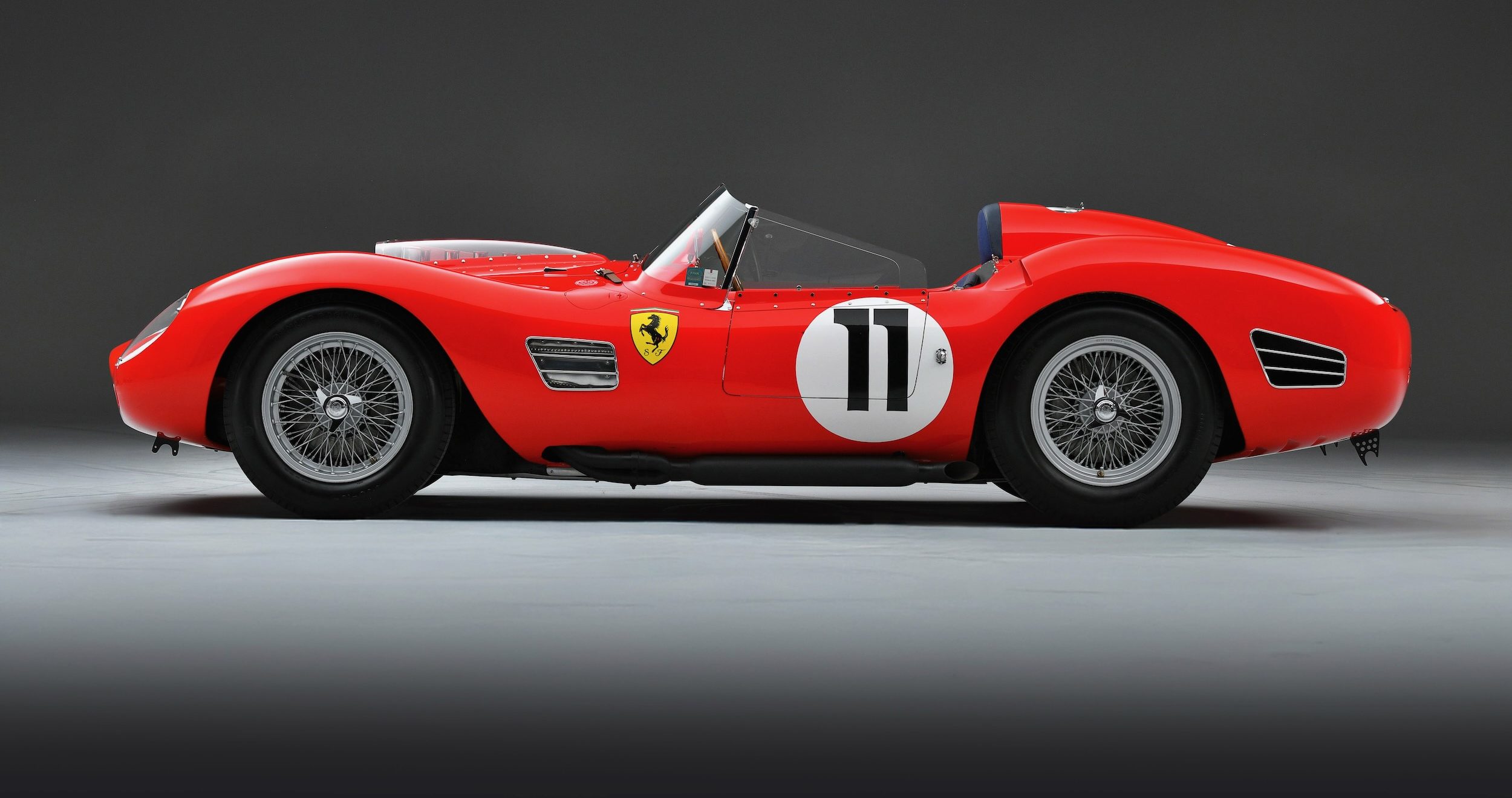
As Tom Hartley Jnr. has just sold #0774TR in August 2026, the car is briefly presented here. The story goes as follows: Aston Martin’s tactics for the 1959 24 Hours of Le Mans were somewhat daring: Stirling Moss was to set a blistering pace in his DBR1/300 right from the start – thereby driving the favoured Ferraris into breakdowns. It worked rather well: as early as the 21st lap, the first Ferrari 250 TR had to throw in the towel; the second on the 41st lap; and the third on the 47th lap. However, on the 70th lap, Moss also suffered a breakdown. Of the six Testa Rossa cars entered, not a single one actually crossed the finish line – including #0774TR with Behra/Gurney; Aston Martin celebrated its first Le Mans victory – and a one-two at that, with Shelby/Salvadori winning ahead of Trintignant/Frère. Driven by Hill/Allison, #0774TR then went on to win the 1,000 kilometres of Buenos Aires in early 1961.


Le Mans 1960 didn’t get off to a good start for Ferrari either: they had miscalculated the fuel consumption. Because the cars had to have significantly taller windscreens that year, the experience gained the previous year was no longer applicable – two of the Scuderia’s 250 Testa Rossa cars came to a standstill on the track in the 22nd hour with empty fuel tanks. Only Paul Frère and Olivier Gendebien narrowly escaped the debacle – and went on to win fairly comfortably in the #0774TR. After the race at La Sarthe, this TR59/60 was sold to the USA, where its engine was transferred to a Lotus XIX; in the 1970s, it was fitted with an engine from a 275 GTB; it was fitted with its original engine again in the 1980s – and was purchased by Peter Goodwin in the early 2000s for a rumoured $75 million. We do not know whether such a large sum of money was involved in the Hartley deal this time round.


We have more Ferraris in our archive.